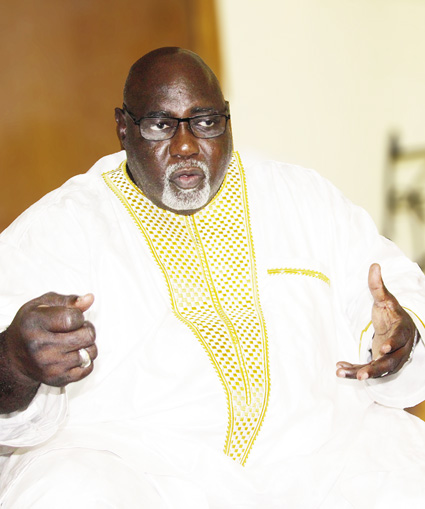
The life and record
<strong>Mahamadi Lamine Kouanda</strong>, also widely known as **El Hadj Mahamadi Kouanda**, was born on **22 October 1955**. His life occupies an unusual position at the intersection of family history, Islam, sport, revolutionary politics and the post-independence public life of Burkina Faso.
He is the **youngest child of Kharim Kouanda** and Kharim's only child with his third wife, a Hausa woman whose family originated in **Kano, Nigeria**. His older siblings were **Omar/Oumarou Kouanda, Fati/Fatimata Kouanda, Hallasane Kouanda and Ousseni Kouanda**.
Mahamadi received **Qur'anic and madrasa education rather than conventional French-language schooling**. His public career therefore did not emerge through the formal academic route normally associated with national political or administrative life.
He became associated from an early age with the **Étoile Filante de Ouagadougou (EFO)**, first briefly as a player and then more significantly through organization and management. From **1971 to 1973** he served as secretary-general for organization, from **1973 to 1975** as vice-president, and between **1977 and 1983** he participated in club leadership while also serving in an assistant-coaching capacity. In **1994** he became president of the football section. During that period the club won the **1993-1994 Burkina Faso championship, the Coupe du Faso in 1994 and 1995, and the Coupe des Leaders**.
His role in football extended beyond the club. He participated in national supporter organization and in **1988** helped create a coordination supporting the **Étalons**, Burkina Faso's national team. After leaving the National Assembly in 2002, he created the **Coordination nationale de soutien aux Étalons**.
Mahamadi has recounted that he first met **Blaise Compaoré in 1973** through football and later came to know **Thomas Sankara** through Compaoré. He subsequently participated in civilian political mobilization associated with the **Revolution of 4 August 1983**, particularly within the environment of **INTER-CDR**. The organization was dissolved in **1988**.
He later became one of the founding figures of the **Congrès pour la démocratie et le progrès (CDP)**, established in 1996. He served in the **National Assembly of Burkina Faso from 1997 to 2002** and remained active in public life afterward. His public record also identifies him as **Commander of the National Order of Burkina Faso**.
In **2020**, after years of internal disagreement within the CDP, Mahamadi left the party and created the **Congrès pour la renaissance et le progrès (CRP)**, which he led as president. In later public activity he emphasized dialogue, reconciliation and national cohesion, and in **2022** was publicly identified as national coordinator of the **Coalition centriste pour la paix**.
For the Digital Kouanda Museum, Mahamadi is also important as a **documented witness to Kouanda and Yarsé historical memory**. His published interviews discuss Yamana, Islam, commerce and oral traditions concerning Yarsé origins.
In one account, Mahamadi described an inherited tradition according to which the Yarsé came from **Yemen** and reached present-day Burkina Faso in connection with **Islam and commerce**.
The Museum preserves that statement as **documented testimony**. It is **not presented as documentary proof of a migration from Yemen**. The testimony establishes that the origin tradition exists within Yarsé and Kouanda memory; the deeper historical question remains open to comparison with archaeology, linguistics, written sources, oral history and scholarship on Yarsé, Wangara, Mandé and wider West African Muslim commercial networks.
Mahamadi Lamine Kouanda's life links family history, Qur'anic education, football, political organization and public testimony. For the Museum, his record belongs both to the history of the **Kouanda family** and to the broader history of **Burkina Faso**.
Connection status: Family authority. The museum states relationships only when a person-specific source or family authority supports them; a shared surname is not treated as genealogy.